Capability portfolio

Six domains. One engineering standard.

Every capability below is delivered the same way in a consortium: as containerised, version-controlled, documented components with defined interfaces, automated tests and a deployment path to the pilot site.

01 · Privacy-preserving AI & cryptography

Learn from sensitive data without ever exposing it

The hardest problem in European data-driven projects is legal, not technical: health records, financial data and industrial telemetry cannot leave their owners. We solve it with cryptographic machine learning, training and inference with mathematical privacy guarantees, not just policy promises.

  • Cross-institution federated learning (Flower, custom aggregation, non-IID robustness)
  • Fully homomorphic encryption (FHE) for inference on encrypted data
  • Zero-knowledge machine learning (ZKML): verifiable inference via zk-SNARKs
  • Secure multi-party computation and differential privacy budgets
  • Post-quantum-ready cryptographic protocol selection
PyTorchFlowerOpenFHE / SEAL Circom / EZKLOpacus
Institution A data stays on-site Institution B data stays on-site Institution C data stays on-site Secure aggregator encrypted updates only differential privacy (ε) Global model returned to every site
Federated learning: model updates travel, patient and industrial data never do

Typical consortium contribution

Privacy work package: threat modelling → protocol design → reference implementation → integration with partner models → pilot validation with DPO/DPIA support.

EU relevance

GDPR-critical use-cases in health (Cluster 1), security (Cluster 3), data spaces and trustworthy AI topics (Cluster 4), European Health Data Space.

02 · Computer vision & edge AI

Perception that runs where the data is created

Cloud round-trips are too slow and too expensive for industrial perception. We compress, quantise and deploy state-of-the-art vision models onto edge hardware - keeping latency low, bandwidth minimal and data on-site by design.

  • Real-time image recognition, object recognition and multi-object tracking (YOLO family, transformer detectors)
  • Human pose estimation for safety analytics and ergonomics
  • Industrial defect and anomaly detection with limited labelled data
  • TensorRT optimisation: INT8 quantisation, pruning, distillation
  • Fleet deployment on NVIDIA Jetson, and TinyML on microcontrollers
YOLOTensorRTNVIDIA Jetson OpenCVONNXDeepStream
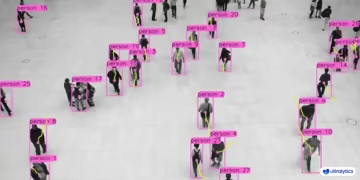
Real YOLO footage: people detected and tracked with bounding boxes and IDs

Real YOLO inference: detection & tracking with persistent IDs. More demos →

Real footage · Ultralytics YOLO

03 · Generative AI & LLM systems

Sovereign language AI for European organisations

We build generative systems that respect European constraints: open-weight models, fine-tuned on your domain, deployed on your infrastructure, with retrieval grounded in your documents, no data leaving the EU, no dependency on external APIs.

  • Enterprise retrieval-augmented generation (RAG) with hybrid search and citation grounding
  • Domain-specific fine-tuning of open-weight LLMs (LoRA, QLoRA, DPO)
  • Multi-agent workflows with strict human-in-the-loop safety protocols
  • Evaluation harnesses: factuality, robustness, multilingual (incl. Greek) quality
  • On-premise and EU-cloud serving with GPU-efficient inference
Open-weight LLMsvLLMLoRA / DPO pgvector / QdrantLangGraph
Documents your corpus, on-prem Chunk + embed multilingual · EL/EN Vector DB hybrid search User query audit-logged LLM open-weight · fine-tuned LoRA / DPO · on-prem Answer with citations
Sovereign RAG: retrieval-grounded answers, zero data egress from your infrastructure

Typical consortium contribution

Language-AI work package: corpus preparation → fine-tuning → RAG integration → multilingual evaluation → pilot deployment with usage analytics and safety monitoring.

EU relevance

Digital Europe AI adoption, Cluster 4 GenAI topics, public-sector digitalisation, European language-technology equality.

04 · Robotics & autonomous systems

Autonomy validated in simulation, proven on site

We develop ROS 2 perception, navigation and manipulation stacks with a simulation-first methodology: every behaviour is stress-tested virtually before a robot moves in an operational environment, cutting pilot risk and cost.

  • Autonomous mobile robots (AMR) for logistics and industrial inspection
  • Robotic manipulation cells: bin picking, machine tending and assembly (MoveIt 2)
  • SLAM, sensor fusion and navigation in GPS-denied environments
  • Vision-guided manipulation and human–robot collaboration safety
  • Gazebo / Isaac Sim digital environments with Sim2Real transfer
ROS 2Nav2Gazebo / Isaac Sim ros2_controlMoveIt 2
Real robot arms performing learned manipulation tasks

Real footage: learned robotic manipulation. More demos →

Real footage · Hugging Face LeRobot

05 · Digital twins & predictive maintenance

A living model of the physical asset

We fuse IoT telemetry, vision streams and historical data into dynamic virtual replicas, enabling zero-risk what-if simulation, energy optimisation and failure prediction for factories, grids and buildings.

  • Sensor-fusion pipelines from PLC/SCADA, IoT and vision sources
  • Predictive-maintenance models with uncertainty quantification
  • Energy-consumption forecasting and optimisation loops
  • Scenario simulation for planning and operator training
  • Open standards: OPC UA, MQTT, NGSI-LD / FIWARE data models
Time-series MLFIWARE / NGSI-LD OPC UA · MQTTGrafana
Physical asset factory line · grid · building PLC / SCADA · IoT · vision Digital twin live virtual replica failure forecasting · what-if energy optimisation telemetry → ← predictions · actions KPIs: downtime ↓ · energy ↓ · forecast accuracy ↑
Closed twin loop: sense → model → predict → optimise → act

Typical consortium contribution

Twin platform work package: data-model design → connector development → predictive analytics → dashboard and decision-support delivery → pilot KPI measurement.

EU relevance

Cluster 4 manufacturing partnerships (Made in Europe), Cluster 5 smart grids and positive-energy districts, resilient infrastructure topics.

06 · Trustworthy AI & MLOps

AI the consortium can defend, to reviewers and regulators

Every model we ship comes with the evidence around it: documentation, explainability, robustness tests and monitoring. This is how project outputs survive review, procurement and the EU AI Act.

  • EU AI Act risk-classification support and conformity-oriented documentation
  • Explainability tooling (SHAP, attention analysis, counterfactuals)
  • Robustness and adversarial testing, bias and drift monitoring
  • Model cards, datasheets and FAIR-aligned data management plans
  • Reproducible pipelines: CI/CD for ML, experiment tracking, versioned datasets
MLflowDVCDocker / K8s SHAPEvidently
Data + training versioned · tracked Evaluation gates bias · robustness · XAI Sign + doc model cards Production EU AI Act evidence Monitoring drift · incidents · KPIs retrain loop
Every model ships with its evidence: gates, signatures, documentation, monitoring

Typical consortium contribution

Cross-cutting trust work package: AI governance framework → documentation templates → automated evaluation infrastructure → compliance reporting across all technical WPs.

EU relevance

Trustworthy-AI topics across all clusters; every project deploying AI in regulated domains needs this role filled.

Need one of these capabilities in your proposal?

We'll map it to concrete tasks, deliverables and KPIs for your call, within 48 hours.

TARGET [0,0]